Mauritius residence permit.
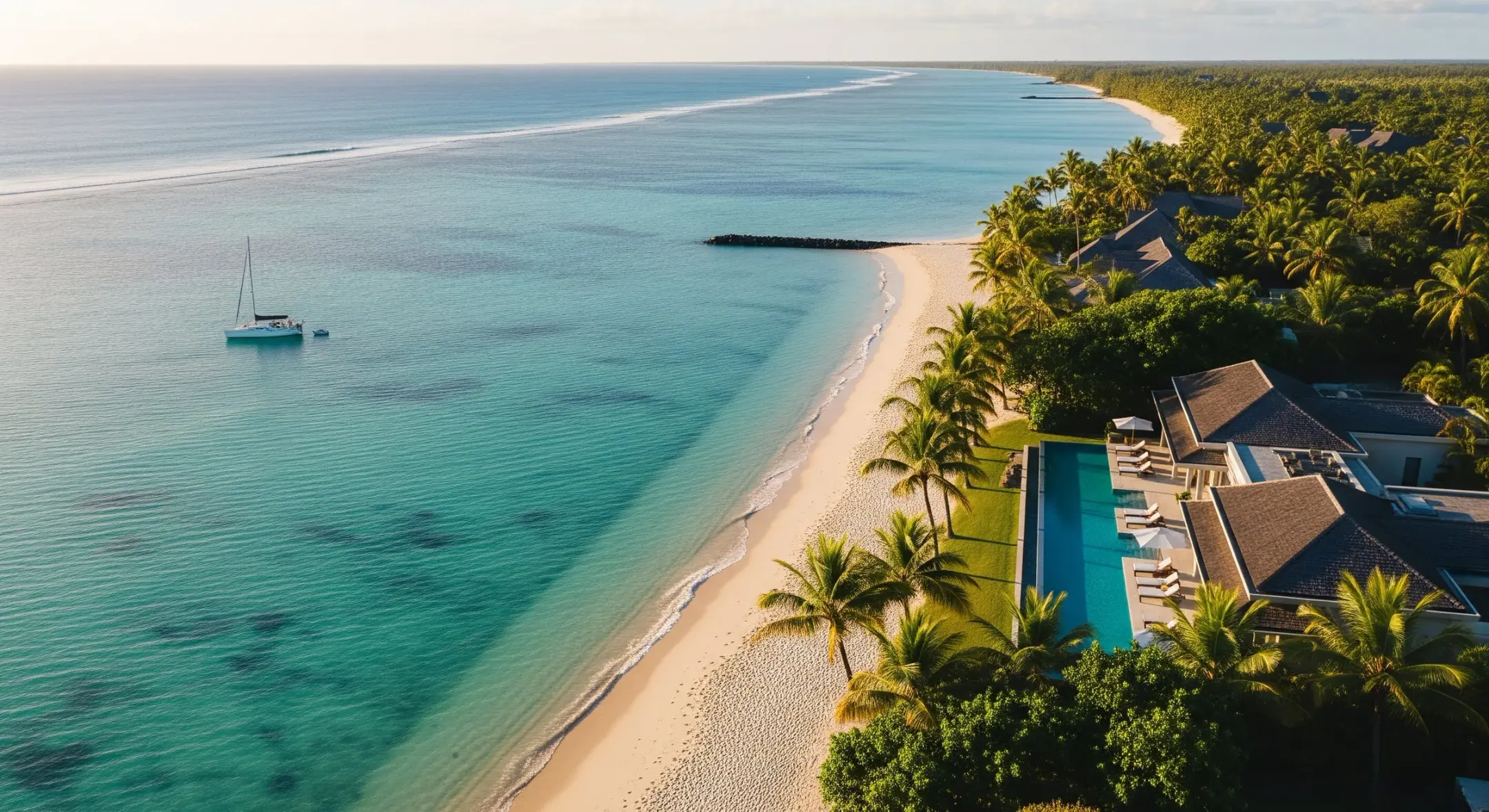
An Indian Ocean island where residency comes with the home you buy — no capital-gains tax, no inheritance tax, no wealth tax, English and French spoken side by side. Beachfront and resort residences along the north coast, from Calodyne to Grand Baie, held for lifestyle, income and a tax-efficient base.
Mauritius is not part of the EU or the Schengen Area. A Mauritian residence permit grants the right to live, work and retire in Mauritius — and eligibility for tax residency — for as long as you hold the qualifying property; it is not a travel document for other countries. A passport that travels follows only through later naturalisation.
What our clients come for.
Residency with the home
Buy a qualifying residence from USD 375,000 under an approved scheme and a Mauritian residence permit follows for you and your family — valid for as long as you own it. No separate fund, no donation.
No CGT, no inheritance tax
No capital gains tax, no inheritance or estate tax, no wealth tax. Personal income tax tops out at 20%, and foreign income is taxed only when remitted to Mauritius.
Holiday homes
Beachfront and resort residences on the island’s sought-after north coast — used privately, let when you are away.
Land & off-plan
Off-plan and development opportunities bought directly from the developer — sourced, vetted and held end to end.
Capital growth
A stable, bilingual, common-law jurisdiction with sustained foreign demand and a deepening luxury-property market.
Rental income
Strong tourism-led short-let and long-let yields, with tenancy, maintenance and management handled discreetly on your behalf.
Built around your situation.
South Africans
Same time zone, a short flight, a SA–Mauritius tax treaty, no CGT or inheritance tax — a natural rand-hedge and relocation base.
French nationals
A large French-speaking community, direct flights, a France–Mauritius treaty and a tax-efficient lifestyle in the sun.
British & Commonwealth
English-speaking, common-law, a UK–Mauritius treaty, and a shorter naturalisation horizon for Commonwealth citizens.
Indian families
Deep historic and business ties, the India–Mauritius treaty, and a stable English-law base for family and capital.
Residences we hold in Mauritius.
A curated selection of residence-qualifying developments — beachfront, resort and urban — sourced and coordinated end to end by 8T20 Capital. Select any residence for its full gallery, floor plans and pricing.
3 residences · sourced & coordinated by 8T20 Capital
Indicative pricing; final figures, availability and VAT are confirmed with the developer and admitted local legal counsel on engagement.
The routes we open.
Mauritius levies no capital gains tax, no inheritance or estate tax and no wealth tax. Personal income tax is progressive to a 20% top rate (a temporary 15% Fair Share Contribution applies to income above MUR 12m), and foreign income is taxed only when remitted to Mauritius, with credit under a network of 40+ double-tax treaties. Final positions are confirmed with licensed Mauritian counsel.
Residence via Property — PDS / IRS / RES / Smart City
From USD 375kA qualifying residence of at least USD 375,000 in an approved scheme grants a Mauritian residence permit to the buyer and dependants, valid for as long as the property is held. Filed with the Economic Development Board. Indicative processing ~3–6 months.
Ground +2 Apartment
Buy from ~USD 147kAny apartment in a building of at least two floors above ground can be bought by a foreigner from MUR 6,000,000 (≈ USD 147,000) — but a residence permit still requires a qualifying USD 375,000+ acquisition.
Occupation Permit — Investor
A ten-year live-and-work permit from a USD 50,000 investment into a Mauritian company, with a route to a 20-year Permanent Residence Permit.
Permanent Residence Permit
20 yearsA 20-year permit for qualifying investors, property owners and retirees — the long-horizon status ahead of any naturalisation.
Retired Non-Citizen (50+)
A ten-year permit for retirees aged 50+ transferring at least USD 2,000 per month (USD 24,000/yr) to Mauritius.
What a Mauritius permit actually does for you.
Beyond the asset itself, this is the real value of the right you hold — the tax position it unlocks, the mobility it adds, what it gives your family, and the protection it quietly puts in place.
A low, flat, territorial-leaning regime: no capital gains tax, no inheritance tax, and foreign income taxed only when you bring it onshore.
Mauritius taxes resident individuals on a near-territorial 'remittance' basis. A resident is taxed on Mauritius-source income, but foreign-source income is taxable only to the extent it is actually received in (remitted to) Mauritius. Personal income tax is genuinely low: effective 1 July 2025 the brackets are 0% on the first MUR 500,000 of annual chargeable income, 10% on the next MUR 500,000, and 20% on the remainder. There is no capital gains tax in Mauritius, and no inheritance, estate, or gift tax, and no net wealth tax. A separate Fair Share Contribution of 15% applies only to very high earners, on net income above MUR 12 million per year (a temporary measure running for the income years from 1 July 2025). You become a tax resident by being present at least 183 days in the income year, or 270 days in aggregate over the current and two preceding years, or by being domiciled in Mauritius.
The leverage is structural, not aggressive. (1) Use the remittance basis deliberately: foreign investment income, dividends, and offshore gains that stay offshore are outside the Mauritius net; you bring in only what you need to fund island living, which is the slice that becomes chargeable. (2) Because Mauritius levies no capital gains tax at all, realising gains on liquid portfolios or on the qualifying property itself while resident is not a domestic taxable event. (3) Time your move so you cross the 183-day residence line cleanly in the year you want the regime to apply, and keep contemporaneous records of remittances versus capital. (4) Coordinate with the double-tax treaty network and, critically, with your home-country exit and CFC rules before you rely on any of this. The regime rewards people who genuinely relocate their centre of life, not those who want a paper address.
Illustrative only - not advice, and ignores any home-country tax. Assume a resident family with USD 1,000,000 of offshore portfolio income for the year and USD 60,000 of capital gains realised offshore, who remit USD 120,000 (roughly MUR 5.5m) into Mauritius to cover living costs. The offshore capital gain: USD 0 Mauritius tax (no CGT). The portfolio income left offshore: USD 0 Mauritius tax (not remitted). On the ~MUR 5.5m remitted and treated as chargeable: roughly 0% on the first MUR 500k, 10% on the next MUR 500k (MUR 50k), and 20% on the ~MUR 4.5m balance (MUR ~900k), for an effective Mauritius bill in the region of MUR 950k (~USD 21,000) - i.e. tax driven by what you brought onshore, not by your global wealth. No Fair Share Contribution applies here because Mauritius net income is below MUR 12m. Your actual outcome depends entirely on your facts and your home jurisdiction.
Tax outcomes are personal and depend on your nationality, domicile, where your income arises, your home country's exit/CFC/anti-avoidance rules, and the relevant tax treaty. The remittance basis, the residence-day tests, and the Fair Share Contribution all have technical conditions, and rates can change at any Budget. Treat every figure here as illustrative and obtain personalised cross-border advice from a qualified adviser before acting.
A residence permit is a right to live in Mauritius - not a new passport. It changes where you can settle, not where your passport lets you travel.
Owning a qualifying PDS property and holding the residence permit gives you and your eligible family the legal right to enter, reside in, and (without a separate work/occupation permit) invest and work in Mauritius for as long as you hold the property. What it does not do is upgrade your passport: visa-free travel always follows your nationality, not your Mauritian residence. So your existing passport's access is unchanged, and a Mauritian residence card by itself is not a travel document for third countries. Mauritius is not in Europe and the permit gives no Schengen or EU rights. Mauritian citizens (a separate, much later question of naturalisation) do enjoy strong mobility - the Mauritian passport carries visa-free or visa-on-arrival access to roughly 145-150 destinations and Schengen visa-free short stays via ETIAS - but that is a citizen's benefit, not something the residence permit confers.
Use the permit for what it actually delivers: a secure, low-friction second home base you can occupy at will, with no minimum-stay obligation to keep the status (it is tied to holding the property, not to days present). That makes it a clean hub for an Indian Ocean and Africa-Asia lifestyle, for hosting family, and - if you later choose to pursue it and meet the long residence and legal conditions - as the foundation for eventual citizenship and the stronger passport that comes with it. For onward travel, continue to plan around your current passport.
Be honest with yourself about geography and documents: this is an African/Indian Ocean base, not European access, and the card is not a passport. Any path to a Mauritian passport is a separate, multi-year naturalisation process with its own strict requirements and is never guaranteed. Visa rules for any third country are determined by your nationality and can change.
One qualifying property covers the whole household - spouse, children, and dependent parents can all hold residence, in a stable, English-speaking, safe island base.
- A single qualifying acquisition above USD 375,000 grants the investor a residence permit, and the spouse and children under 24 are granted residence permits alongside the main applicant.
- Dependents - spouse, dependent children (including stepchildren and lawfully adopted children), and dependent parents - can be added; once a complete dependent file is accepted by the Economic Development Board, the dependent permit is typically issued within about 10 days.
- No separate work or occupation permit is needed: as a PDS resident you may invest and work in Mauritius, so a relocating spouse can take up employment or run a business.
- Status is durable and effort-light: the permit lasts for as long as you hold the property, with no minimum physical-presence requirement to maintain it - useful for a multi-country family.
- Bilingual, common-law jurisdiction (English and French), politically stable, with a temperate lifestyle and low violent-crime profile relative to the family's likely home alternatives.
- No inheritance, estate, or gift tax in Mauritius, which simplifies passing the family base and onshore assets to the next generation (subject to home-country estate rules).
Mauritius has a well-established international-school sector concentrated around the north (Grand Baie/Pamplemousses), the central plateau (Moka, Quatre Bornes), and the west coast (Tamarin/Flic en Flac). Northfields International runs British curriculum with IB and Montessori options from nursery to A-level equivalent; Le Bocage International offers a full IB continuum (MYP, Diploma, Career-related); and Westcoast International / WISS delivers Cambridge Lower Secondary, IGCSE and the IB Diploma. As an indication, fees range from roughly MUR 160,000 to MUR 600,000+ per child per year depending on year group, so budget on the order of MUR 700,000-1,200,000 a year in tuition for two secondary-age children. Pathways feed naturally into UK, European, and international universities.
Private healthcare is genuinely strong for an island this size. C-Care Wellkin is the largest and most modern private hospital, with around 190 specialists and 40+ specialties; Apollo Bramwell (Apollo Hospitals group) is known for complex surgery, oncology and cardiovascular care; and C-Care Darné (Fortis partnership) brings international group standards. The private sector invests in advanced imaging and robotic surgery and coordinates well for planned and complex procedures, which is why Mauritius positions itself as a regional medical-tourism destination. Families should carry international private medical insurance and plan, for the most specialised tertiary care, on possible referral abroad - the standard pattern for any small jurisdiction.
A pre-secured legal right to live in a calm, neutral, Indian Ocean jurisdiction - arranged in good times, ready if home becomes unstable.
If conditions at home deteriorate - political instability, conflict, currency or capital controls, a hostile shift for your family - the value of having already secured Mauritian residence is that the legal question is settled in advance. You are not applying under pressure or queuing for a visa in a crisis; you and your spouse, children, and dependent parents already hold the right to enter and reside in a stable, non-aligned country with a familiar legal system and language. It also diversifies your currency and asset exposure away from a single home economy into a hard-asset property base and an onshore footprint denominated outside the rand.
The protection is legal certainty and optionality, held permanently. Because the permit is tied to holding the property rather than to days spent on the island, it does not lapse while you wait, and there is no minimum-stay test to keep it alive. The right to enter and reside - plus the right to work and invest without a further permit - means that if you do relocate, the family can actually live and earn there, not merely visit. And because Mauritius has no inheritance, estate, or gift tax and no capital gains tax, the base you build is straightforward to hold and pass on.
Keep it travel-ready in calm times: hold valid passports for every family member, keep the residence cards current and the qualifying property in good standing, and keep digital and physical copies of the EDB approval, title deed, and permits. If you need to move quickly, you book commercial flights to Mauritius as the permit holders you already are and enter on your residence status - no fresh application, no consular wait. Pre-arrange the practical layer in advance: a local bank relationship, a school place or two held where possible, a doctor, and a lawyer or relationship manager on the island who can act on your behalf. The faster you can move is determined by ordinary travel logistics, not by immigration approval, because the approval is already done.
Be precise about what this is: a pre-secured legal RIGHT to enter and reside in a safe jurisdiction - it is not an evacuation service, and 8T20 cannot extract anyone from a conflict zone. Reaching Mauritius still depends on you being able to travel and on commercial flights operating. The permit is conditional on continuing to hold the qualifying property; let the property go and the residence right ends. This is insurance you arrange while you can, precisely so you never have to arrange it when you can't.
What it costs, end to end.
Set your programme, property value and family — see the full upfront cost, the ongoing obligations and an indicative timeline, instantly.
Registration / land-transfer duty for non-citizens under EDB schemes rose from 5% to 10% from 1 July 2026 (Finance Act 2025). Most purchases starting now complete after that date.
- 1Reservation & due diligence1–2 wks
- 2Notarised deed & payment2–4 wks
- 3EDB residence application filed4–8 wks
- 4Residence permit issued~3–6 mo
Indicative for planning only. Final figures — fees, taxes and timelines — are confirmed in writing by licensed counsel on engagement.
One relationship, the whole journey.
Your residence permit is the goal — we coordinate the whole journey to it as a single engagement: advisory, the qualifying investment, the application and aftercare, with licensed local counsel throughout.
Advisory & selection
We confirm eligibility and shape the residence route around your family — the permit first, everything built around it.
Qualifying investments
The single qualifying property your route requires, sourced and vetted — the step that secures residency.
Submission of applications
Every government form prepared, checked and lodged through licensed local counsel.
Aftercare & support
Renewals, your records and your asset looked after for as long as you hold.
Application drafting and lodgement are performed with and through licensed local counsel. 8T20 Capital coordinates the engagement and the qualifying investment; regulated legal, tax and immigration work is delivered by licensed local professionals. We are not a law, tax or immigration firm.
You decide. You instruct. We keep it on track.
Below: how the process unfolds, and where we coordinate, direct and keep it on track.
Mauritius grants a renewable residence permit to any non-citizen who acquires an EDB-approved residential property (apartment, townhouse, villa, penthouse or duplex under the Property Development Scheme, Smart City Scheme or a comparable IRS/RES development) for at least USD 375,000. The permit is issued under the Immigration Act and EDB (PDS) Regulations 2015, and it stays in force for as long as you continue to own the qualifying property — it is not a fixed-term investor visa that expires. It exempts you from any separate work or occupation permit, so you may live, invest and work in Mauritius. The structure of the file (entity choice, the title deed, the EDB online filing, all document assembly) is coordinated and project-managed by 8T20, who direct admitted Mauritian counsel through each regulated step; the one part the law reserves to you in person is a single trip to Mauritius after approval-in-principle for biometrics, original-document verification and the three local medical tests.
Approximately 4 to 7 months from engagement to the residence permit being endorsed: ~2-4 weeks to select and reserve the unit and assemble documents, the EDB residence-permit assessment typically runs 2-6 months, then a single ~3-7 day in-person trip after Approval-in-Principle to complete biometrics, document verification and medical tests before the permit is issued.
One in-person visit to Mauritius is legally required. After the EDB/Prime Minister's Office issues your Approval-in-Principle (valid 90 days), you must travel to Mauritius to (1) attend the biometric enrolment and identity appointment, (2) present your original documents for verification by the EDB and the Passport & Immigration Office, and (3) complete the three compulsory medical tests (Hepatitis B surface antigen, HIV and chest X-ray) which by law must be done at a Mauritian clinic. A single trip of about 3-7 days covers all of this. Everything before and after that trip — reserving the property, signing the deed (executable by counsel under POA), the EDB online filing, document legalisation and the final permit collection — is coordinated remotely, with us directing counsel and the issuing authorities through each step so the file keeps moving. Each accompanying family member must also attend their own biometrics and complete the same medical tests in Mauritius.
- 01
Engagement, structuring & property selection
Handled togetherUnder Power of Attorney1-3 weeksWe confirm eligibility, agree the holding structure (personal name, company, société or trust — each is recognised by the EDB for residence purposes) and shortlist EDB-approved PDS / Smart City units that clear the USD 375,000 threshold. You choose the unit; we verify the developer holds a valid PDS Certificate so the residence entitlement actually attaches to the purchase.
Your part — Decide on the property and the holding structure, and confirm source-of-funds for the purchase price.
- 02
Reservation & preliminary sale agreement
We coordinate itUnder Power of Attorney1-2 weeksWe reserve the chosen unit and negotiate/review the reservation contract and preliminary deed (often a VEFA / off-plan sale agreement). The notary and the developer's PDS company are engaged. The purchase price must be paid in a freely convertible currency and the registration duty paid to the Registrar-General.
Your part — Sign the reservation/preliminary agreement — or grant a Power of Attorney so counsel signs it for you — and transfer the deposit.
- 03
Notarised title deed & property registration
Our local teamUnder Power of Attorney2-4 weeksThe Mauritian notary draws the title deed; on payment of the price and registration duty the property is registered and transcribed. The PDS company then notifies the EDB Chief Executive Officer of the registration and supplies a Notary Certificate confirming the deed is duly registered and stating the price — this Notary Certificate is the document that unlocks the residence-permit application.
Your part — Execute the deed (this can be signed by an admitted Mauritian notary/attorney acting under your Power of Attorney — no travel needed for completion) and settle the balance plus duty.
- 04
Assemble & legalise the residence-permit dossier
We coordinate itUnder Power of AttorneyPer family member2-4 weeksWe coordinate assembly of the EDB residence-permit pack for you and each dependent and direct counsel through it: the 'application to enter Mauritius' residence-permit form, authenticated copies of passport (first pages) and birth certificate, a police/morality certificate dated within 6 months, a marriage certificate or certificat de concubinage for a couple, two passport photos per person, the UID form, and the Notary Certificate. The medical certificate is finalised on arrival (see the Mauritius medical step).
Your part — Provide your passport, birth/marriage certificates, and obtain a police clearance from your country of origin (covering the last 10 years, issued within the last 6 months). We direct the legalisation/apostille and sworn translation through licensed professionals and track each document so nothing lapses.
- 05
EDB online residence-permit filing & agency verification
We coordinate itUnder Power of Attorney2-6 months (EDB assessment)We instruct counsel to lodge the residence-permit application through the EDB online portal, and project-manage the filing so it goes in correctly and on time. It is then routed for verification across the relevant agencies (EDB, Passport & Immigration Office, Prime Minister's Office) and assessed. We monitor the file and direct counsel's responses to any requests for additional information so it keeps moving.
- 06
Approval-in-Principle issued (90-day window opens)
We coordinate itUnder Power of AttorneyIssued at end of assessment; valid 90 daysOn a favourable assessment the Prime Minister's Office issues an Approval-in-Principle, valid for 90 days. Important honesty point: the Approval-in-Principle is NOT a visa to enter Mauritius — it is the green light to come and complete biometrics, verification and the medical tests within that 90-day window. We line up your travel/entry document and schedule your appointments.
- 07
Travel to Mauritius for compulsory medical tests
Handled togetherIn personPer family member1 day (within the in-person trip)By law the three medical tests — Hepatitis B surface antigen, HIV and chest X-ray — must be carried out at a Mauritian laboratory/clinic registered with the Ministry of Health. We pre-book the clinic; the visit itself is quick and the certificate (valid 6 months) is issued locally and lodged with your file.
Your part — Attend the clinic in person and take the Hepatitis B, HIV and chest X-ray tests. This is legally irreducible — it cannot be done abroad or under POA. Each family member does their own.
- 08
In-person biometrics & original-document verification
Handled togetherIn personPer family member1 day (within the in-person trip)You attend the EDB / Passport & Immigration Office appointment for biometric enrolment (photograph and fingerprints) and personal identification, and present your original documents so the EDB and PIO can verify them against the copies already filed. This is the core legally-mandated in-person act of the whole process.
Your part — Appear in person for biometrics and bring all original documents for verification. This cannot be delegated or done under POA. Each accompanying family member attends their own biometrics appointment.
- 09
Residence permit issued & endorsed
We coordinate itUnder Power of Attorney1-3 weeks after the appointmentsOnce biometrics, verification and medicals are cleared, the residence permit is granted under the Immigration Act and endorsed. It remains in force for as long as you hold the qualifying property, exempts you from any work/occupation permit, and extends to your registered dependents. We coordinate collection of the permit cards and hand over the complete file.
Steps, durations and government fees for Mauritius are indicative and verified to official sources; the regulated legal work is performed by our admitted local team, and final positions are confirmed in writing before you commit. Programme rules change — we re-confirm yours at the time of filing.
Read it now — the full printable dossier.
Programme routes, the at-a-glance facts, an indicative cost breakdown, the document checklist and the process — as a branded document you can print or save to PDF.
Receive the Mauritius dossier.
Programme details, requirements, timelines and current pricing — prepared for your situation and sent to you, with a private consultation to follow.
The essentials.
Let’s arrange a call.
Choose a time that suits you and Andrew will call you personally. We map the Mauritius route, the cost and the timeline around your family — privately, and without obligation.